
Accelerating ALS discovery through shared, accessible, and deeply integrated research data
by Ann K Novakowski, Jessica Malenfant, Ram Ayyala, Vanessa Barone, and Susheel Varma
Key |
Value |
|---|---|
authors |
Ann K Novakowski, Jessica Malenfant, Ram Ayyala, Vanessa Barone, and Susheel Varma |
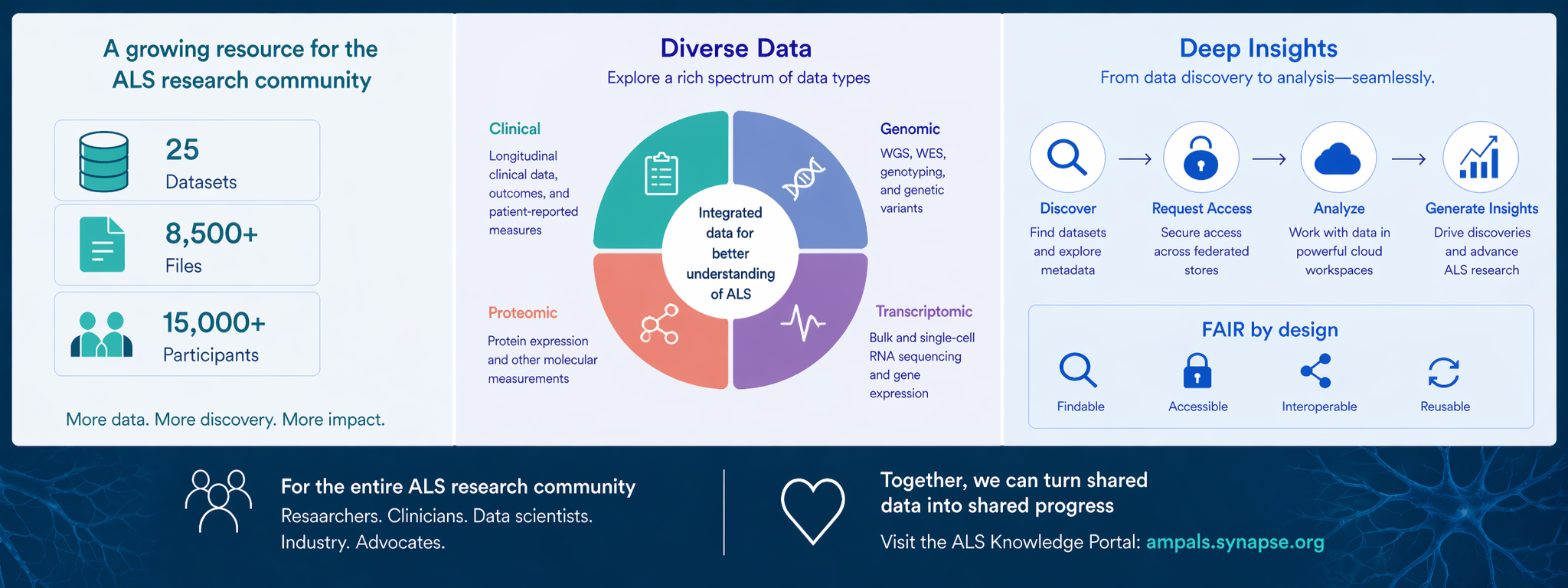
Our teams at Sage Bionetworks believe that we can meaningfully impact ALS research by providing access to high-quality, well-organized data. We're proud to announce the launch of the ALS Knowledge Portal, a resource built to accelerate discoveries and drive the development of effective ALS treatments.
What This Means for ALS Research
ALS remains a devastating disease. Actor Eric Dane’s story was reported on earlier this year, following his death. It is a story among countless untold stories of families affected by the disease. The ALS Association notes that it is typical for individuals to survive just two to five years after a diagnosis because treatment options are limited. There is no cure, and the need for therapeutic innovation is urgent. Large, well-characterized datasets have historically been scattered across institutions, slowing discovery and analysis. When researchers can’t easily find or access data, the path from scientific insight to therapeutic breakthroughs is longer than it needs to be, leaving patients and families to wait.
Disease Burden & Projections
U.S. Prevalence at 35,000 in 2026: According to the National ALS Registry (CDC), approximately 35,000 Americans will be living with ALS in 2026. This is the equivalent of 10 people per 100,000 (based on 2025 data).
25% Global Increase by 2040: A recent study co-authored by researchers in the U.S. and Italy projects a 24.9% median increase in ALS prevalence globally by 2040 due to improvements in living conditions that, in turn, contribute to populations living longer.
Predictive Modeling for Treatments: Researchers in Italy provide a predictive model online for researchers and clinicians to predict incidence and prevalence, including in the context of new treatment options, to support ongoing investments in research.
Our goal is to help researchers move faster, collaborate more effectively, and uncover insights from fragmented, siloed data that have limited scientific breakthroughs.
What is the ALS Knowledge Portal?
The ALS Knowledge Portal is part of the Accelerating Medicines Partnership® ALS (AMP® ALS) initiative funded by the NIH, FNIH, and FDA. It brings together clinical and genomic datasets spanning multiple repositories, including the RDCA-DAP and GEO into one public-facing portal.
The portal is more than a data warehouse. Our teams are working to harmonize data and integrate the portal with various cloud-based analytical workbenches. We believe this central gateway to shared knowledge can help speed science and maximize our researchers’ impact. It hosts a rich spectrum of ALS research data, including clinical (e.g., ALS Functional Rating Scale–Revised (ALSFRS-R) scores, survival and progression metrics, patient-reported outcomes, and longitudinal natural history data) and genomic data (e.g., bulk RNA sequencing, single-cell RNA sequencing, gene expression profiles, whole genome and exome sequencing, and multi-omics datasets).
Today, the portal includes:
24 datasets (or data collections) spanning clinical, genomic, and molecular research
8,500 data files available for exploration and analysis
Data from 20 studies and 47 cohorts
Contributions representing 15,216 participants
As new studies and data types are added, the portal will continue to expand. The integration of these data, with biospecimen data expected in 2026, provides researchers with what they need to identify biomarkers, validate therapeutic targets, and better understand how to improve disease outcomes.
How it Works
Researchers can explore datasets through structured, searchable metadata (indexed from multiple repositories), request access to controlled-access data, and analyze data in connected cloud environments, avoiding the need to move data in and out of systems. We are actively working to end an era of fragmented systems by introducing this federated data and centralized discovery approach.
Indexed data, such as from the RDCA-DAP, can be explored from the portal, and once data of interest is identified, researchers are directed to the appropriate request form to request access. Once access is granted, data may be downloaded locally to a compliant environment or analyzed from an integrated workbench. Additional information about access can be found on our ALS Portal Docs site.
Who Benefits
The Portal aims to reduce the friction we see today. Our goal is to strengthen connections across the ALS research community, which includes grassroots patient advocates, clinicians, computational biologists, data scientists, translational researchers, and industry partners alike. Researchers developing machine learning models, testing new hypotheses, and exploring disease progression patterns have a powerful new resource to draw on.
The Future of ALS Research
The launch of the ALS Knowledge Portal is an important milestone. We are setting out an important journey to accelerate science and be part of the pipeline that translates discoveries into positive treatment outcomes for families who are impacted by ALS.
We invite you to explore the portal, discover the data available, and join a community committed to advancing ALS research through open science. We welcome your participation and your feedback!
Visit the portal today: https://ampals.synapse.org/